Graph-Enhanced RAG Knowledge Platform
An enterprise RAG platform built from the ground up to solve the two things vector-only retrieval can't: complex-table extraction and multi-hop reasoning across thousands of pages of technical documentation. Incubated for automotive aftersales, now in production across three verticals — automotive, pharma, and media. The system is built on three pillars working together: LLM-driven Agentic Indexing that reads documents the way a human does, a knowledge-graph retrieval layer that reasons across entities scattered through long manuals, and a bounding-box citation system that makes every answer one-click verifiable to the exact paragraph on the exact page.
Complete user journey — from knowledge ingestion and graph inspection, to Q&A with LLM answers and bounding-box source citation
Project Background
Incubated from the automotive industry, then productised across pharma and media & entertainment — now in production at 11 enterprise customers across three verticals.
4 Classic Automotive Use Cases
Fault Mode & Effects Analysis across thousands of pages of technical documentation
Step-by-step retrieval from service manuals for field technicians
Rapid onboarding and knowledge transfer for after-sales service teams
Accurate and cited answers to customer queries from product knowledge bases
Production Outcome: Vector-Only vs. Graph-Enhanced
In the first production deployment — automotive after-sales at a commercial vehicle OEM — repair knowledge sat in thousands of manuals and work orders across multiple languages. A vector-only RAG baseline topped out around 75% accuracy, which is not close enough when a wrong answer means a wrong repair. Rebuilding the knowledge layer as Graph-Enhanced RAG on Neptune, OpenSearch, and Bedrock lifted answer accuracy past 90% — the system reasons over how parts, fault codes, and repair procedures actually relate, not just what looks semantically similar.
Measured on the production deployment. The 95%+ below is a different number: the 100-question competitive bake-off the customer authored during vendor selection.
Three Pillars of the Platform
Each pillar maps directly to a pain point vector-only RAG cannot solve on its own.
LLM-driven parsing that preserves table structure, captions images, and chunks by semantic unit.
Knowledge graph enables multi-hop reasoning across entities scattered through long manuals.
Bounding-box precision — one-click verify to the exact paragraph on the exact page.
Technical Solutions
Agentic Indexing
Entity and relationship extraction is driven by configurable LLM prompt templates — ops teams can tune the extraction schema per document type (automotive service manual, pharma regulatory filing, embedded datasheet) without touching code. This is what makes the same platform generalise across three verticals.
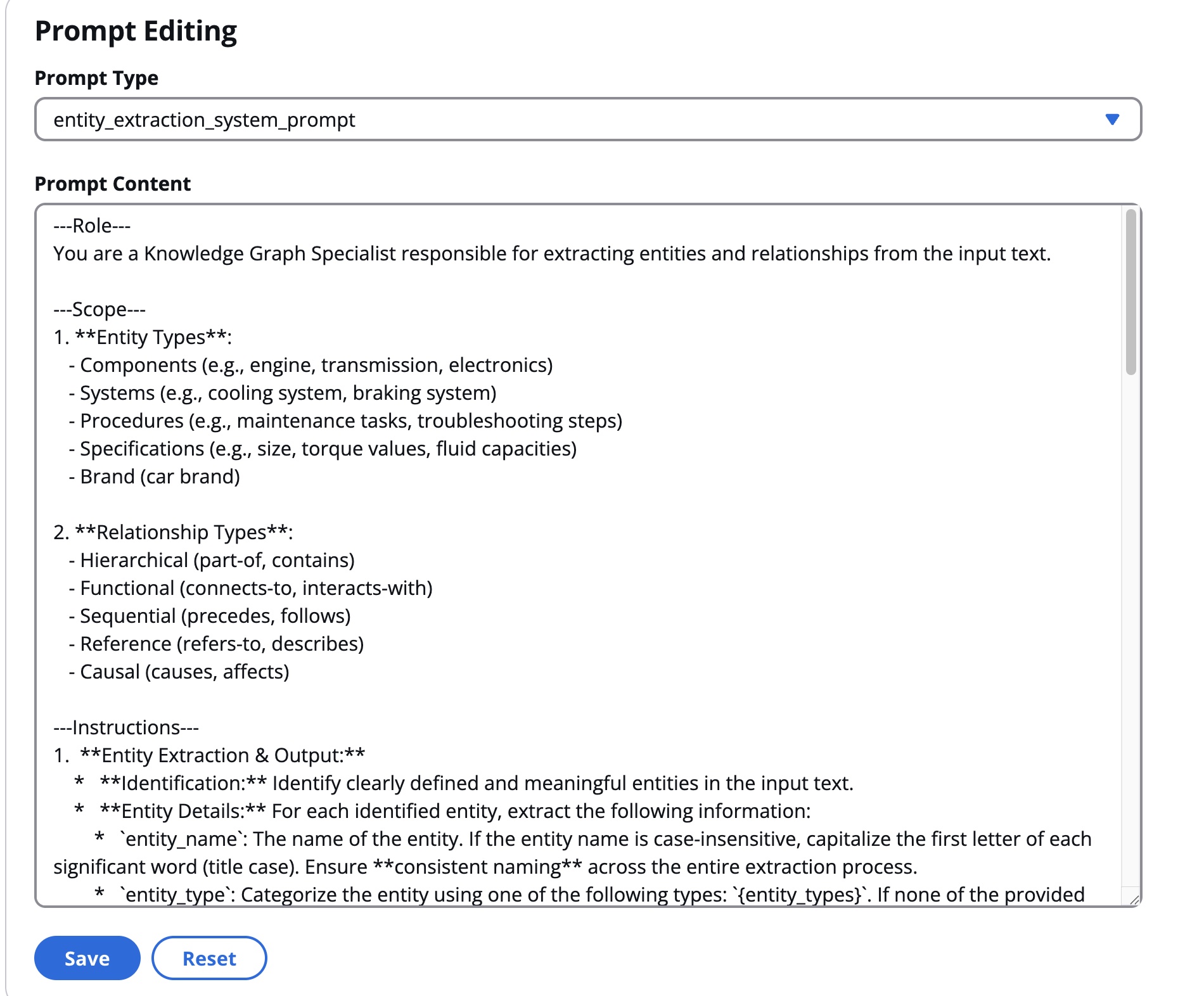
Prompt editor UI — entity and relationship extraction templates powering Agentic Indexing
Multi-hop Reasoning via Knowledge Graph
The system retrieves relevant entities and relationships from the knowledge graph, surfacing them as additional retrieval context — enabling reasoning chains that span multiple documents. This fundamentally solves what traditional vector RAG cannot achieve.
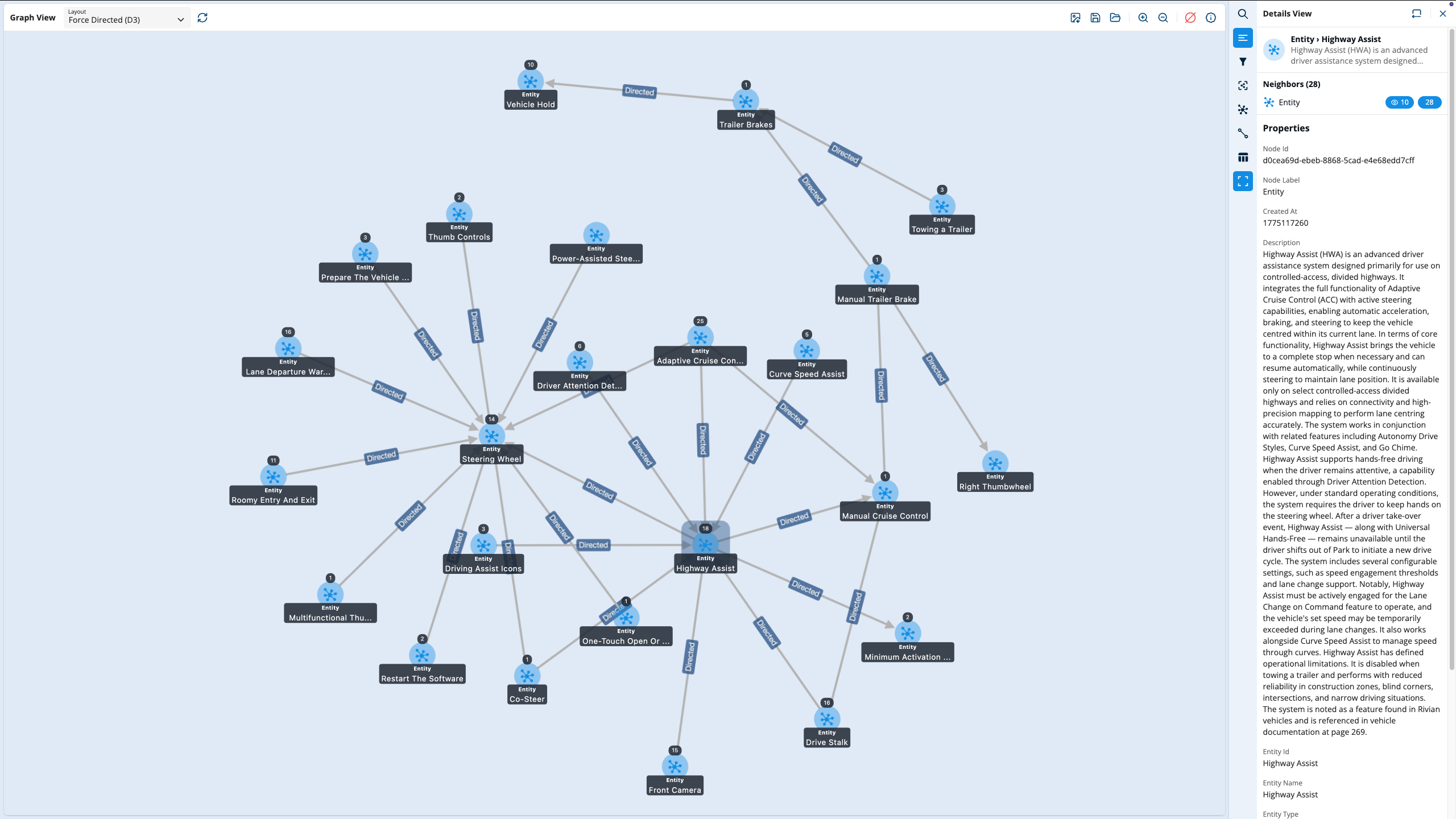
Knowledge graph storage in Neptune — entity vertices and relationship edges traversed at query time for multi-hop reasoning
PDF Object-Level Precise Citation
End-to-end bounding-box-level source traceability pipeline — from document parsing through chunk indexing to cross-page frontend rendering — achieving line-level citation precision. Became the decisive differentiator in every competitive bid against Azure GraphRAG, Alibaba Cloud, open-source RAGFlow, and research-team alternatives.
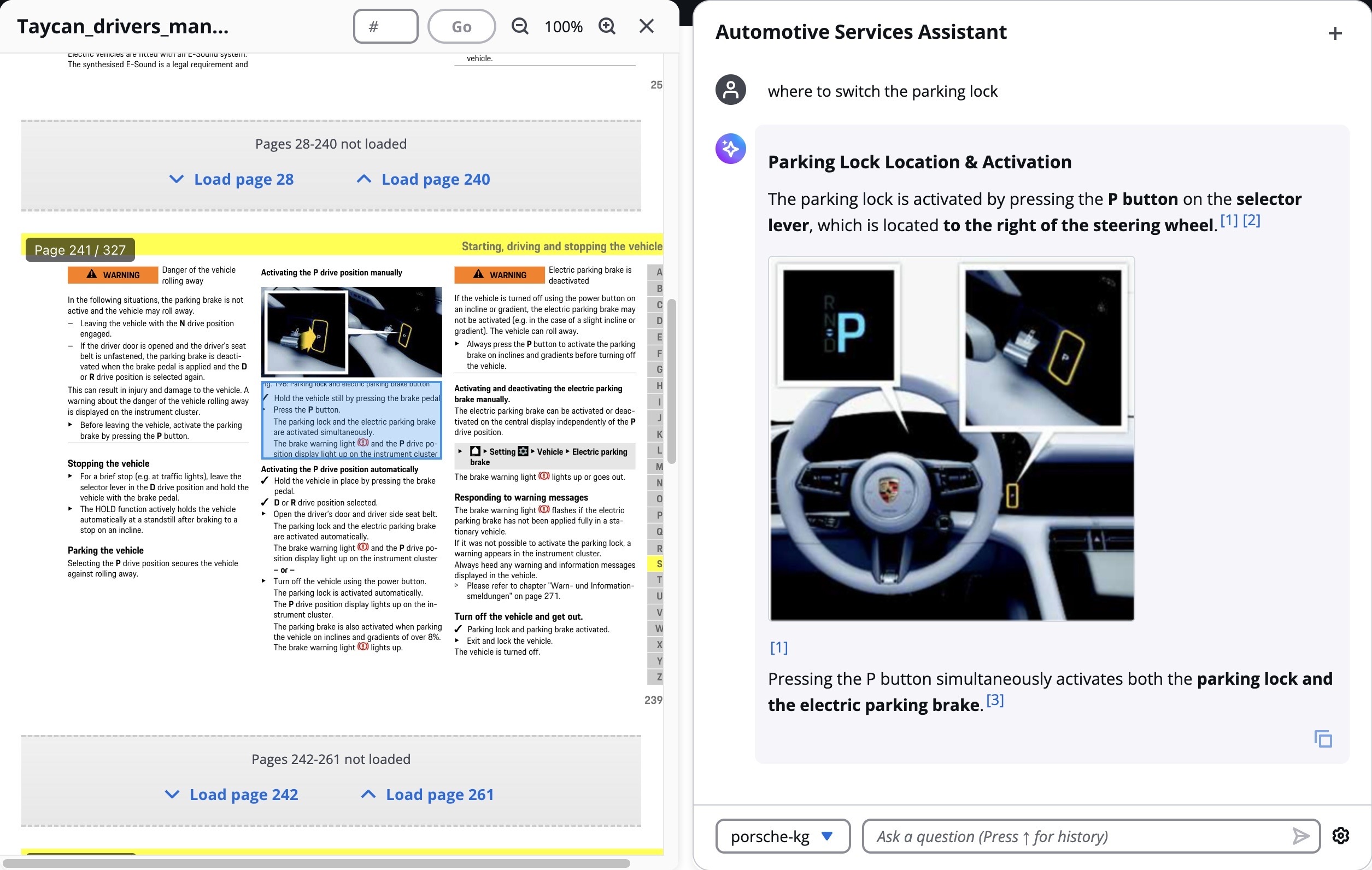
Automotive OEM manual: complex multi-column PDF layout citation
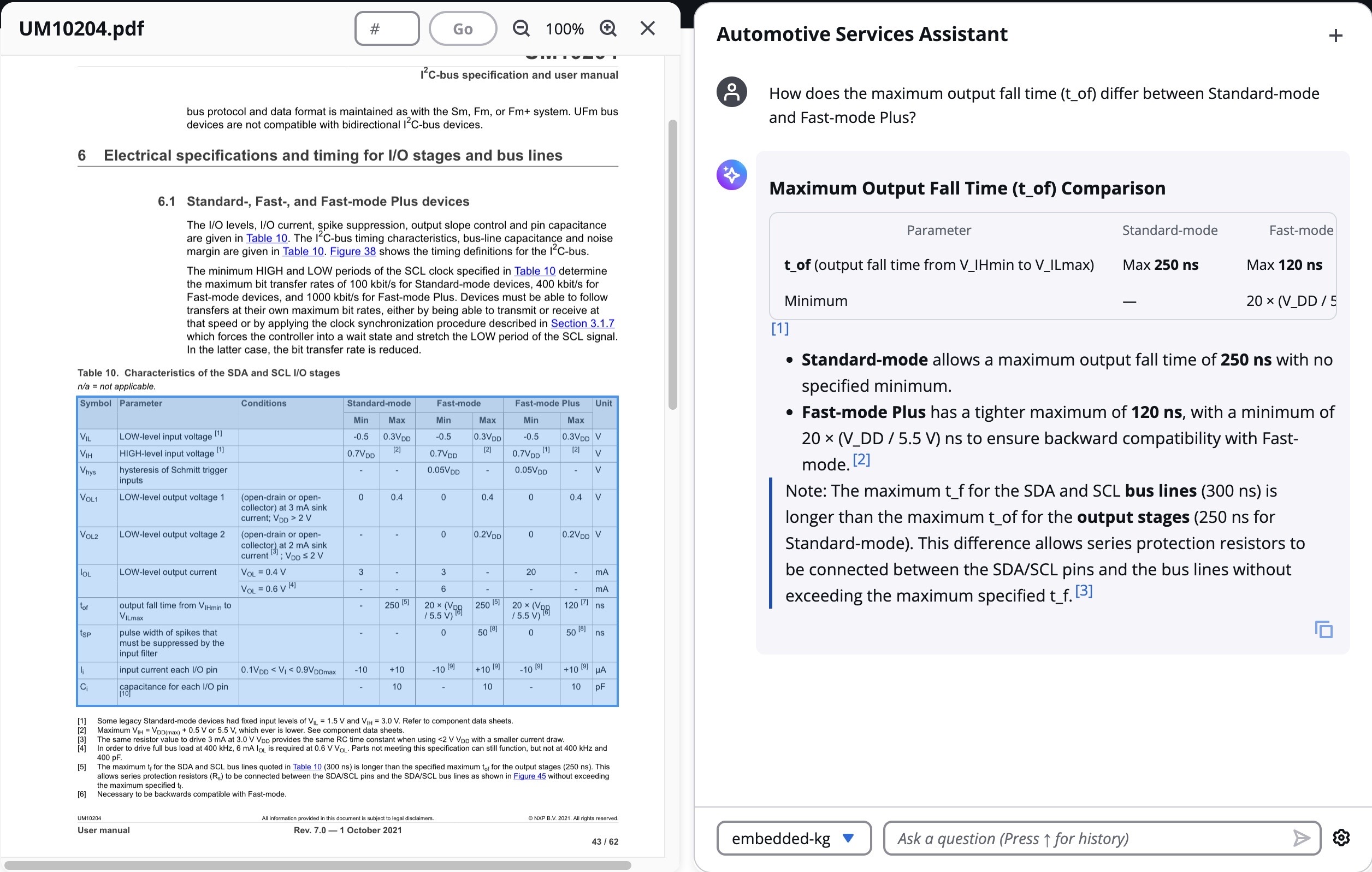
Embedded systems (I2C): complex data sheet with merged-cell table citation
Two Hard Problems Behind Line-Level Citation
✕The PDF parser tags every text element with BBox coordinates. Traditional fixed-size chunking splits those coordinate tags in half, making line-level traceability impossible.
✓Invert the paradigm: aggregate up, don't split down. Start from the lowest-level PDF object JSON sequence and aggregate upward until the configured chunk size is reached — eliminating the possibility of breaking a coordinate boundary by design.
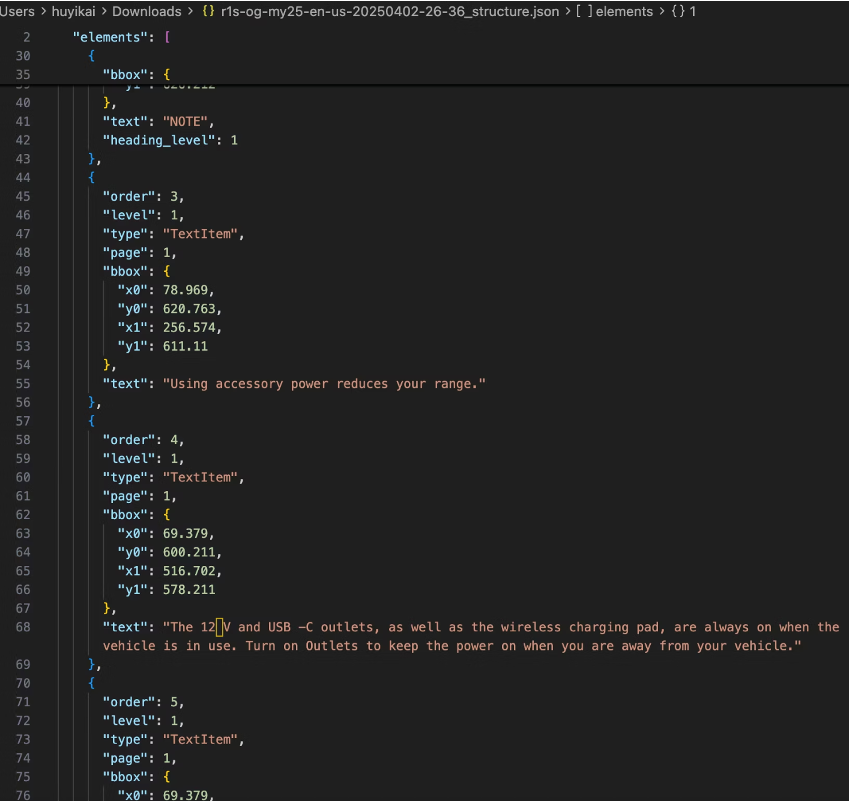
Bottom-level PDF parse output — every bullet point carries its own page number and bounding-box coordinates
✕In a PDF, every list item and small paragraph has its own coordinates. Using them directly for citation produces a scatter of tiny, fragmented highlights — a terrible verification experience.
✓Semantic BBox merging. Use tables, images, and section headers as semantic boundaries, and merge all contiguous text elements between boundaries into a single coherent semantic unit. Clicking a citation now highlights a meaningful passage, not confetti.
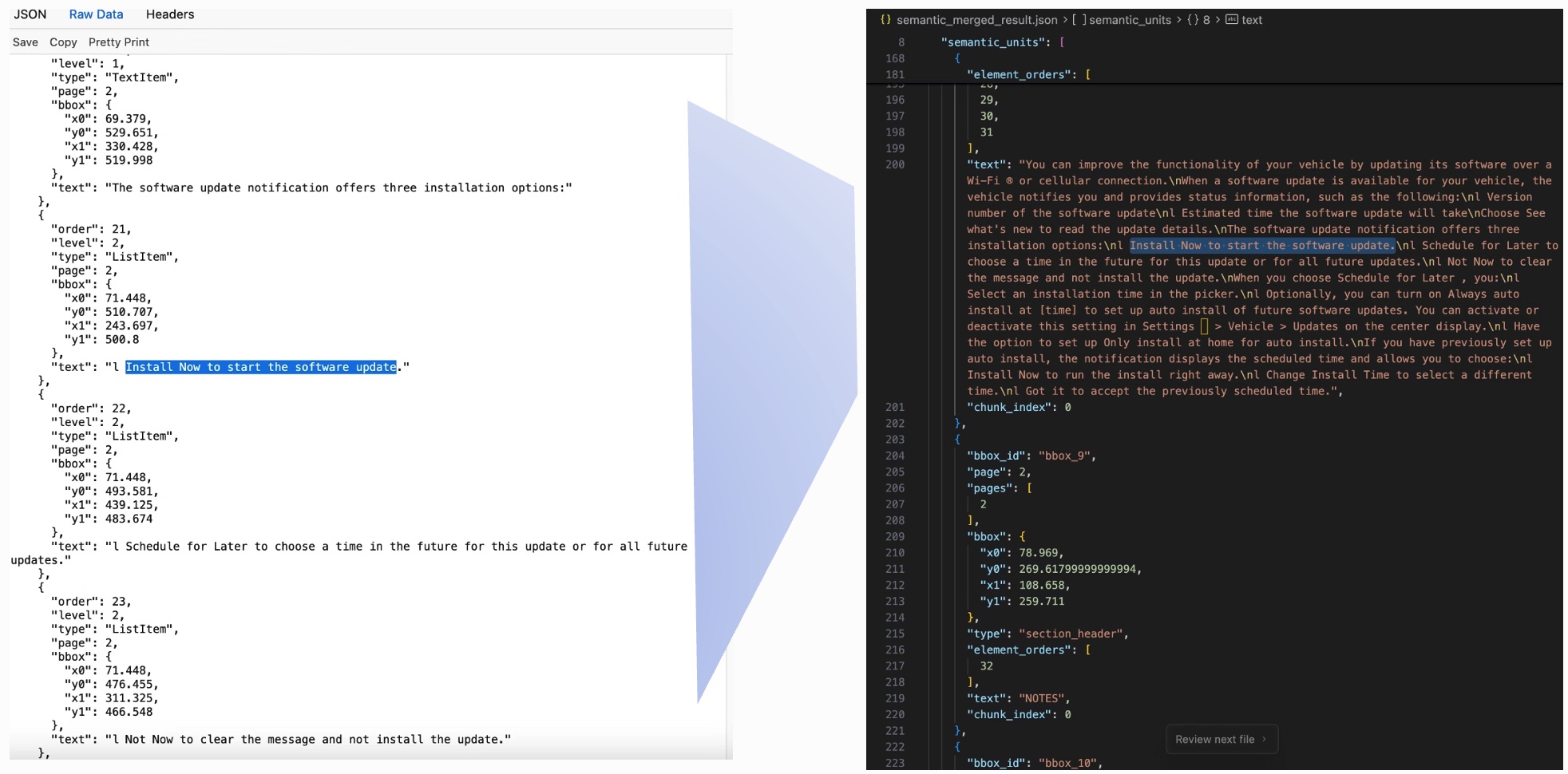
Semantic BBox merging — fragmented per-element boxes collapsed into coherent semantic units
Benchmark: Two Layers of Validation
The platform was validated against two benchmarks — a controlled internal study isolating the effect of the graph layer, and a real customer-authored competitive bake-off against the strongest alternatives on the market.
A 28-question evaluation on a representative automotive owner's manual, built on LightRAG, comparing Graph + Vector (Mix mode) against Vector-only (Naive mode) across 5 LLMs (Win/Lose/Tie scoring). The graph-enhanced approach wins on all 5 models — confirming the lift comes from the graph layer itself, independent of the base model.
A 100-question benchmark authored and scored by a leading commercial vehicle OEM over their 3,000+ page service manuals. Four alternatives evaluated in parallel: Azure GraphRAG, Alibaba Cloud, open-source RAGFlow, and a Chinese university research lab. Result: 95%+ accuracy vs. ~80% runner-up — reframed in the deal as "15 fewer wrong repairs per 100 queries," the stat that closed the contract.
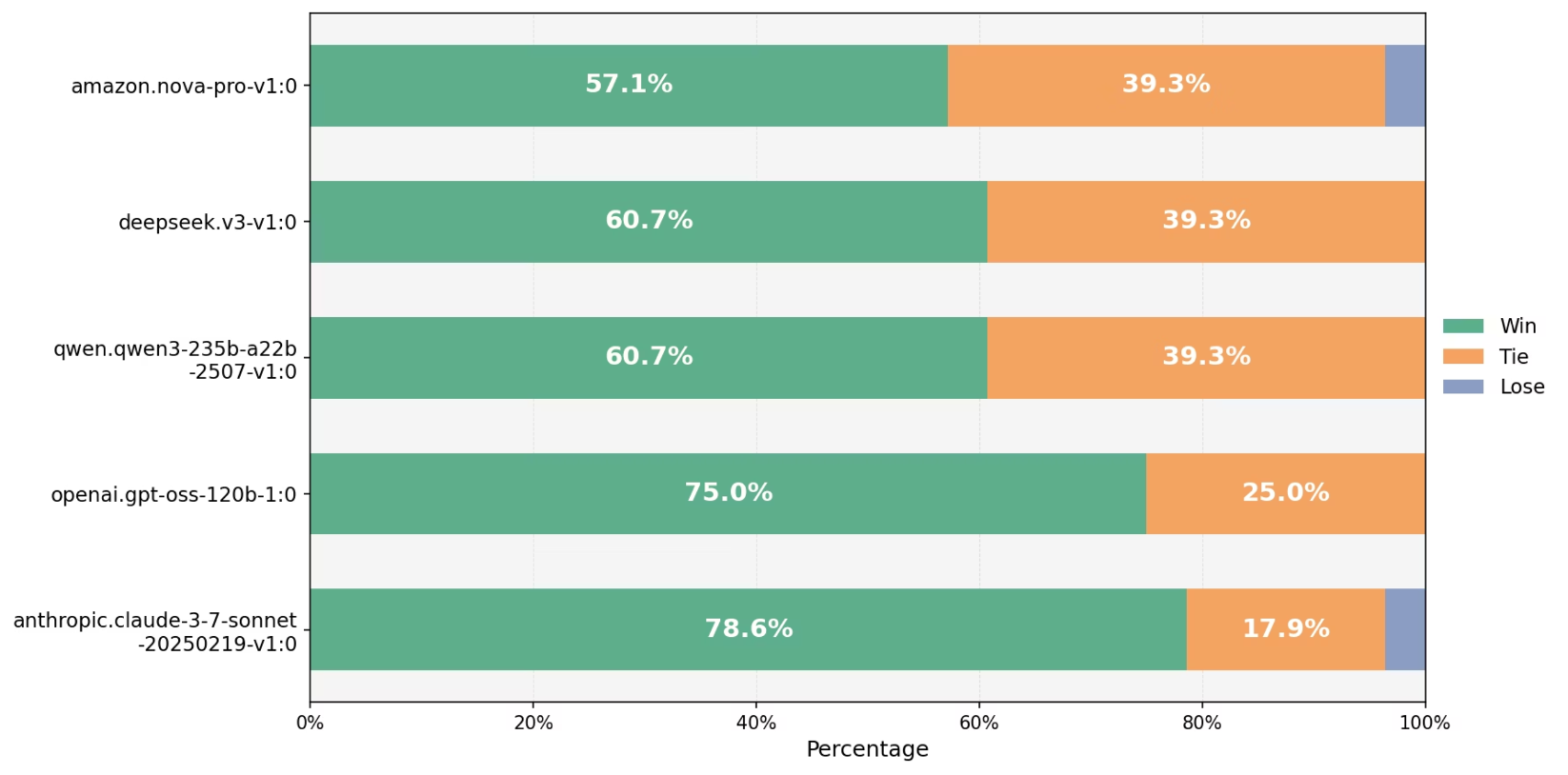
Internal benchmark results: Graph + Vector vs Vector-only — Win/Lose/Tie across 5 LLM models
MCP Extension — Cross-Industry Integration
FastMCP server exposing 7 knowledge base tools with OIDC (Cognito) and API Key dual authentication — enabling plug-and-play integration into customers' existing agentic frameworks (Dify, LangGraph, Strands SDK, AgentCore). Demo: Kiro IDE integration for embedded I2C code generation — demonstrating applicability across industries beyond automotive.
MCP demo: Kiro integration generating embedded I2C code from the knowledge base
System Overview: Ingestion & Retrieval
Two pipelines, one dual-track index — documents flow into a hybrid graph+vector store on ingestion, and both indices are queried in parallel on retrieval.
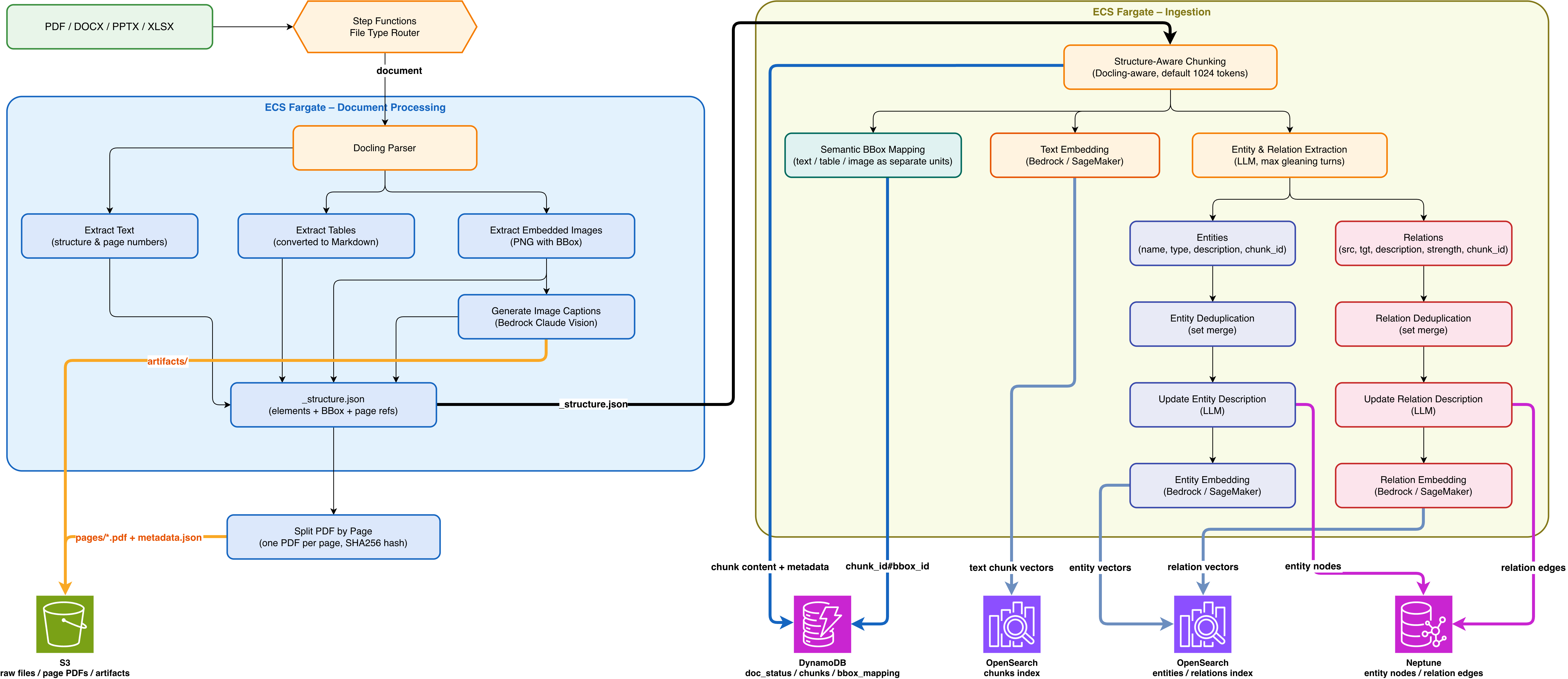
Ingestion pipeline — LLM-driven parsing, entity & relationship extraction, dual-track storage into Neptune (graph) and OpenSearch (vector)
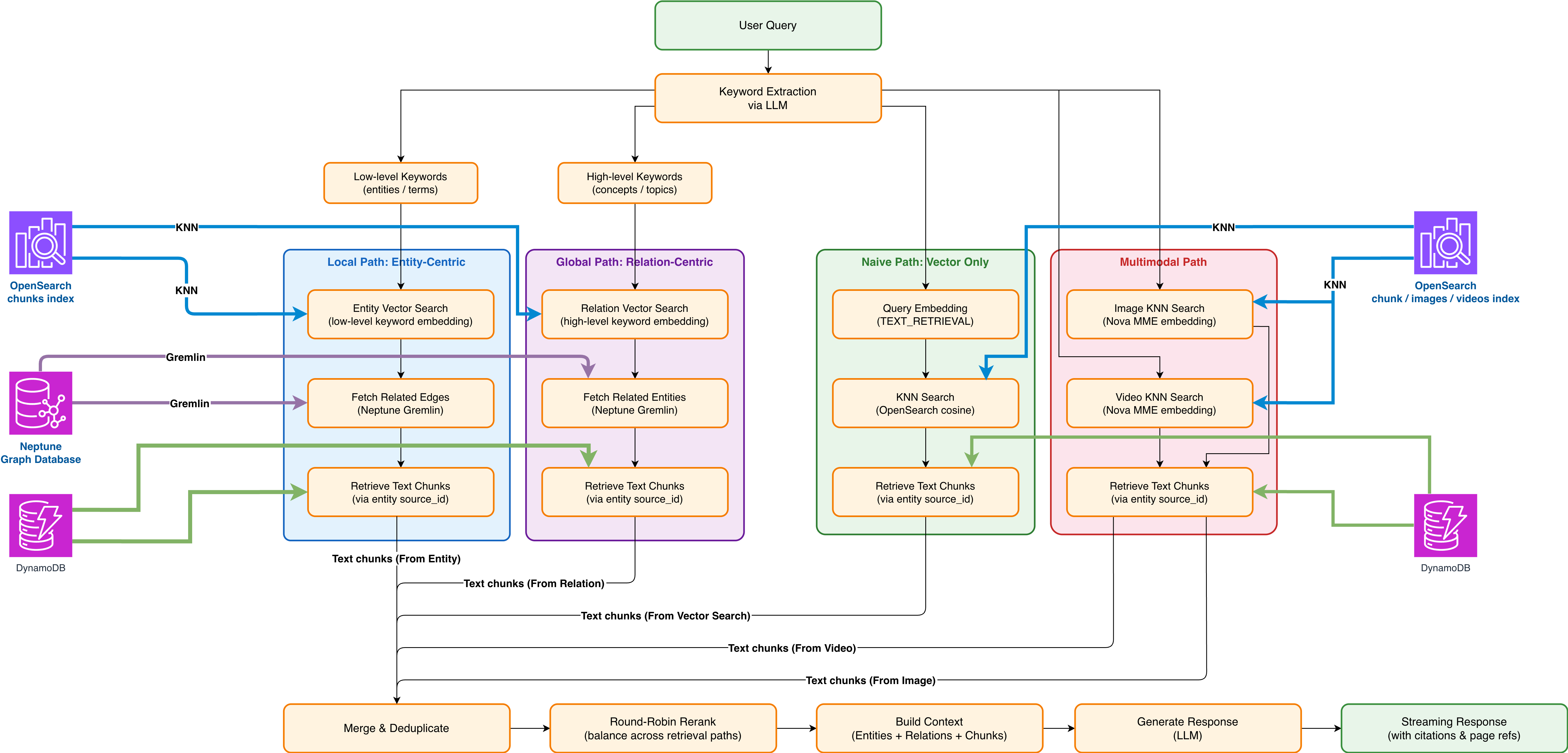
Retrieval pipeline — dual-path retrieval (graph + vector), result fusion, and LLM response generation with bounding-box citations
Storage Layer: What Lives Where
Four AWS managed services, each with a distinct role. All four enforce multi-tenant data isolation via context_id.
- ›Entity vertices — name, type, description
- ›Relationship edges — typed source→target with description
- ›Powers multi-hop traversal for Graph Search
- ›Chunk text + embedding vectors
- ›Entity description embeddings
- ›Relationship description embeddings — triple-index vector search
- ›BBOX_MAPPING — chunk_id + bbox_id → page & coordinates (backbone of line-level citation)
- ›Full document text, chunk records, entity & relation tables
- ›Document processing status + LLM response cache
- ›Raw uploaded documents (PDF / Word / PPT)
- ›Per-page split PDFs for the citation viewer
- ›Docling parse artifacts + extracted images + DynamoDB overflow (>200KB)
System Architecture
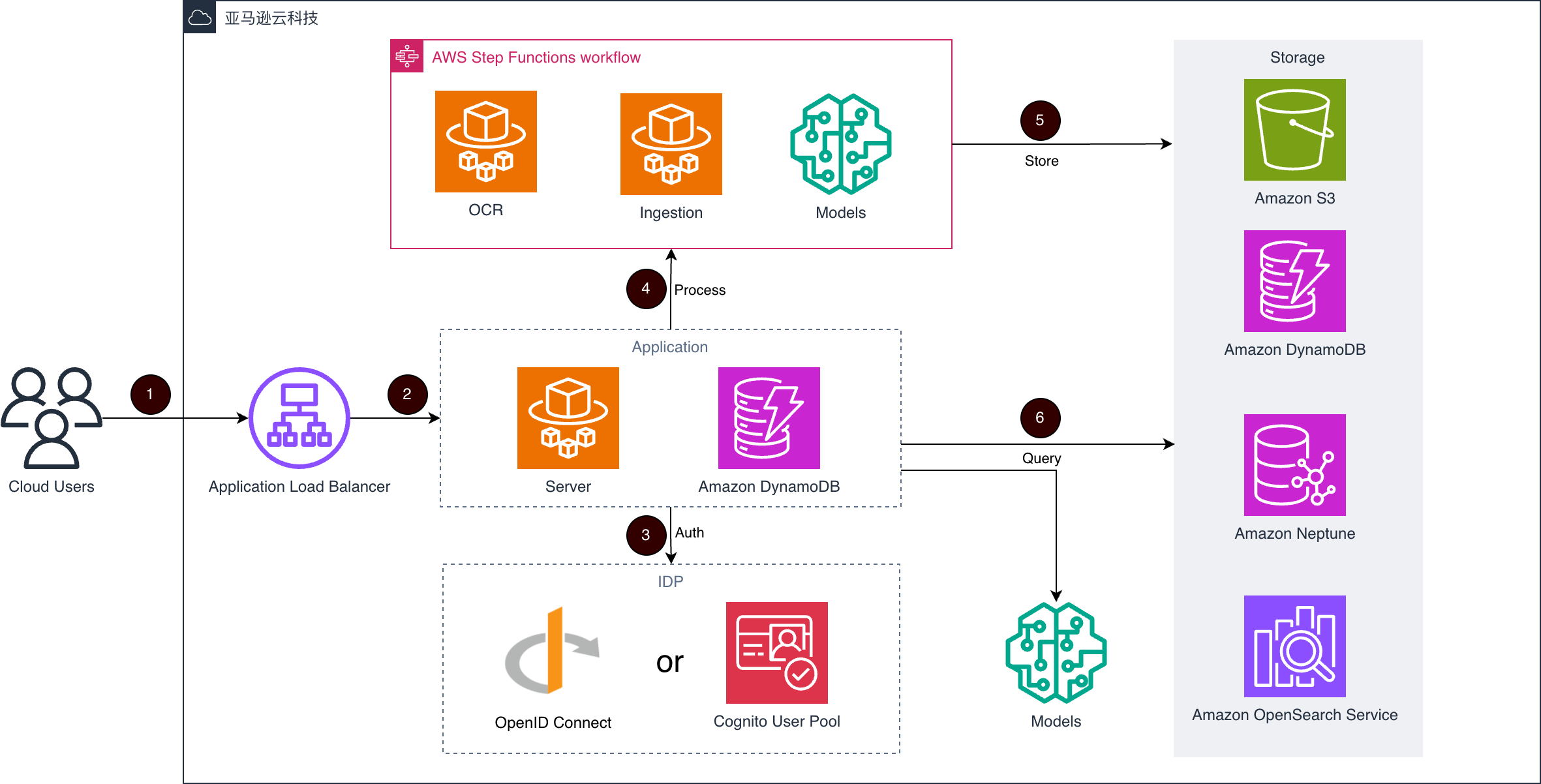
Hybrid graph-vector architecture on AWS managed services: Neptune knowledge graph + OpenSearch vector retrieval + DynamoDB metadata
Project Metrics
Competitive Advantages
95%+ accuracy on a 100-question customer-authored benchmark over 3,000+ page technical manuals — beating Azure GraphRAG, Alibaba Cloud, open-source RAGFlow, and a Chinese university research lab on recall, multi-hop reasoning, and complex table retrieval.
Bounding-box-level PDF citation provides line-level source traceability — consistently the decisive factor in competitive conversions, reframed with customers as "15 fewer wrong repairs per 100 queries."
Re-architected from LightRAG's single-node design to fully managed AWS-native (Neptune + OpenSearch + DynamoDB + S3), supporting enterprise-grade deployment without single points of failure — the productisation lever behind 26% POC-to-production conversion.
Tech Stack
Graph AI & Search
AI/ML & Orchestration
Backend & Data
Document & Media Processing
Infrastructure & Deployment
All data, metrics, screenshots, and demos shown are based on publicly available information or anonymized data.